The Science of Reiki: A Tensorial Perspective
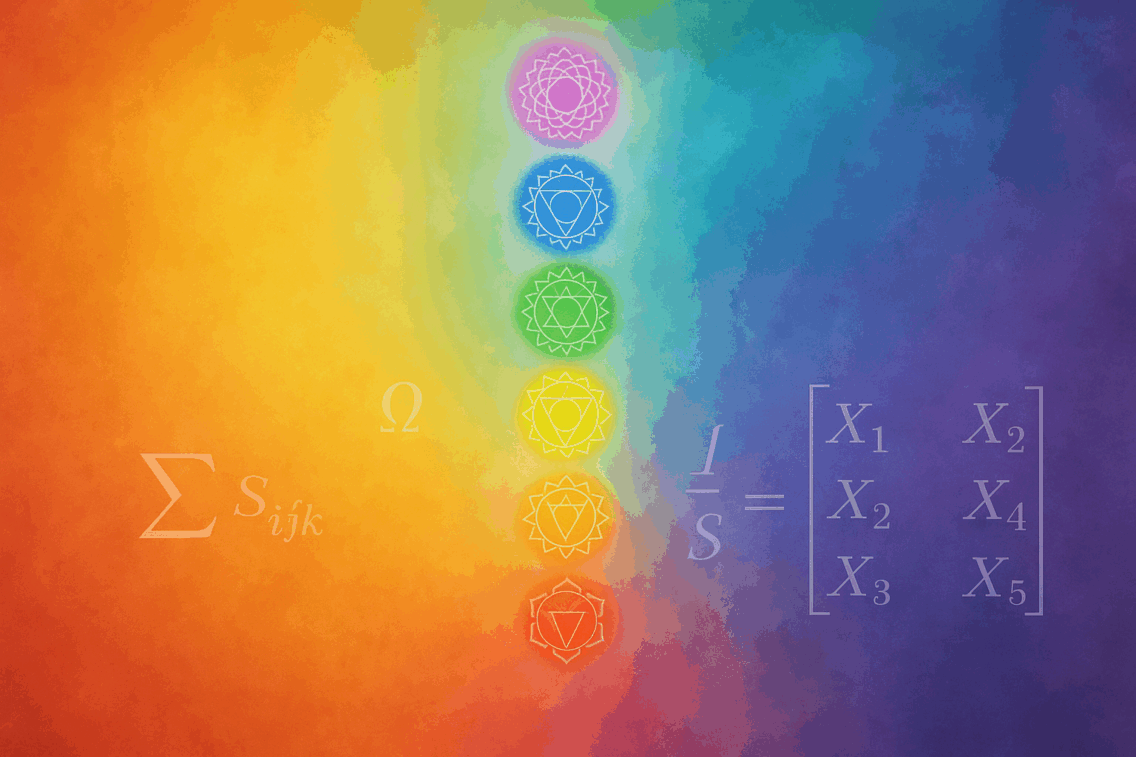
As a Reiki Master, I have long witnessed the subtle but powerful transformations that arise when Reiki symbols are invoked. Yet, in our modern age, we are also called to give language to these mysteries in a way that bridges intuition with science. In this blog, I share a framework that expresses Reiki energy in mathematical terms, showing how the flow of life force can be modeled with vectors, covectors, matrices, and tensors.
The State of Being: 7 Chakras and 5 Harmonics
In Reiki, our energetic state is defined by 12 dimensions:
- 7 chakras: root, sacral, solar, heart, throat, ajna, crown
- 5 harmonics: grounding, compassion, shadow work, integration, unity
The chakras can be thought of as a 7‑dimensional vector, each component representing the current energetic level of a chakra.
The harmonics can be understood as covectors — functional overlays that describe how energy is expressed, integrated, or blocked. These five influences “read” the state of the chakras and produce scalar values.
Together, the chakras and harmonics define your current state of being.
From State to Matrix
When the chakra vector and the harmonic covector are combined, they form an outer product — a two‑dimensional structure, or matrix, of shape (7, 5). This is the state matrix:
- 7 rows: chakra energies
- 5 columns: harmonic activations
This matrix encodes how your chakra system interacts with each of the five harmonics.
Reiki Symbols as Rank‑3 Tensors
A Reiki symbol is more than a picture or mantra — it is a transformation operator that acts upon your state matrix.
Mathematically, we can describe a Reiki symbol as a rank‑3 tensor of shape (7, 7, 5):
- Input chakra dimension (7)
- Output chakra dimension (7)
- Harmonic dimension (5)
Each element of this tensor tells us how much of a given input chakra, under the influence of a specific harmonic, flows into an output chakra.
Transformation Process
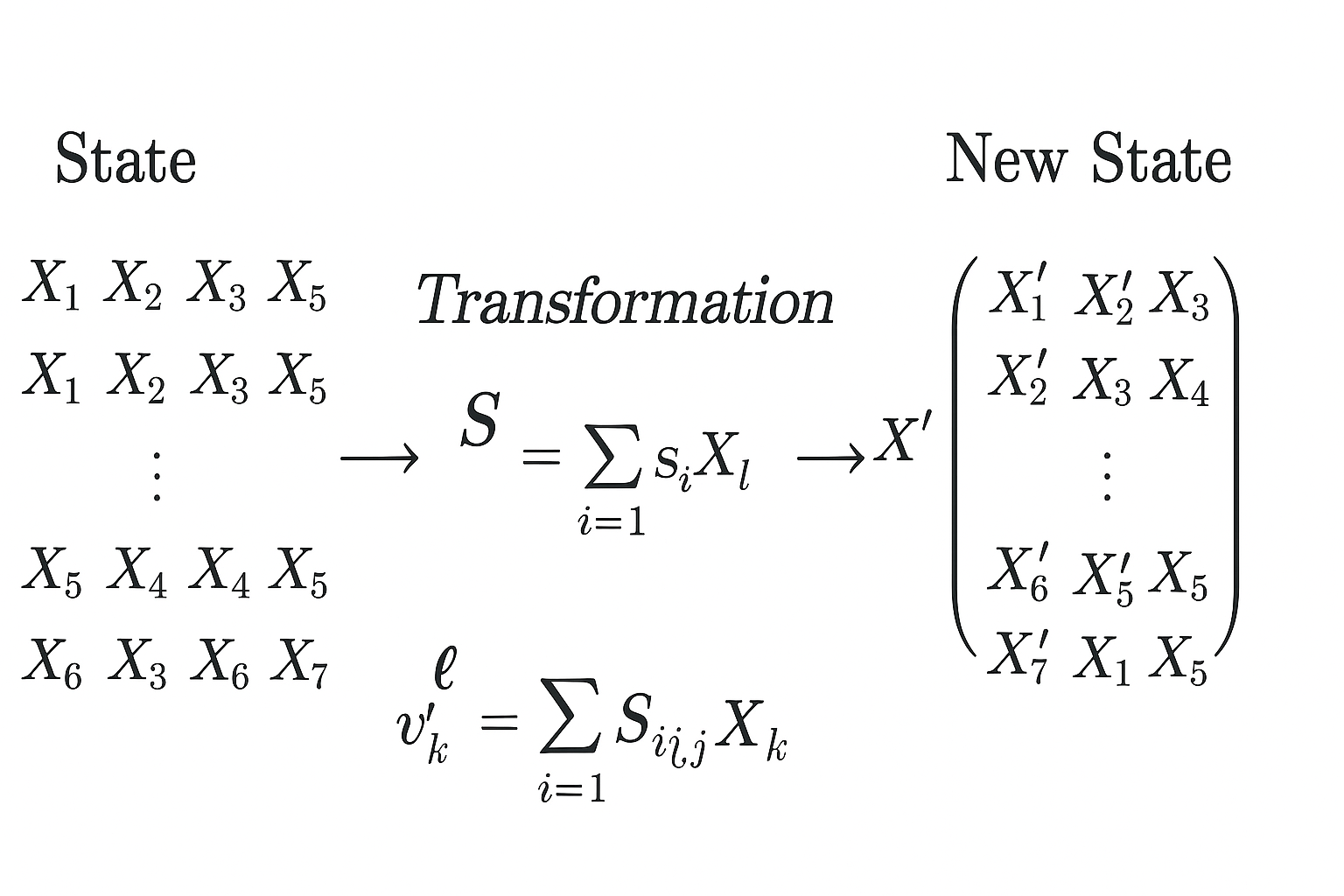
- Define the state: start with a chakra vector (7 components) and harmonic covector (5 components).
- Form the state matrix: outer product of chakras × harmonics = shape
(7, 5). - Apply the symbol tensor: the Reiki symbol contracts with the state matrix, producing a new chakra vector (shape 7).
- Re‑evaluate harmonics: recalculated from the new chakra vector, restoring the system to a fresh state of
7 + 5.
This is the cycle of Reiki transformation: state → matrix → symbol → new state.
Why This Matters
Understanding Reiki in this language does not diminish its sacredness — it enhances our ability to communicate across traditions. When we say a Reiki symbol “balances emotions” or “amplifies grounding,” we can now point to the actual structure of the tensor: which chakra‑harmonic pathways are lit up, and how energy is redistributed.
It also affirms what practitioners already feel: most Reiki symbols are sparse operators. They do not act on all 245 potential pathways (7×7×5), but only on a patterned subset. This is why each symbol has its distinct character.
Closing Thoughts
Reiki is both art and science. We draw the symbols with reverence, we chant their names, and we feel the current of Source moving through us. Yet at the same time, we may now say: a Reiki symbol is a tensorial transformation that reorganizes the energy state of body and spirit.
This union of intuition and mathematics reflects the deeper truth of Reiki itself: integration within, unity beyond.